


The first time I went to go buy a pair of binoculars, I figured, “Well, they’re all the same, no? Binoculars are binoculars!” It turns out that they’re surprisingly intricate, and the more you research, the more overwhelming it can get! Like, am I supposed to know what “exit pupil” is?!
This guide here is the one I wish I had years ago, when I was drudging through reviews and YouTube videos. Now, I can confidently say that I am capable of slowing things down and explaining binoculars in a way that by the end, we’ll leave no stone unturned.
Whether you’re buying binoculars for wildlife watching, birding, safaris, hiking, sports, travel, stargazing, or just general outdoor curiosity, this article walks through every major concept you need to understand before spending your money.
Don’t worry, I’m not going to overwhelm you with specs. We’re getting straight to the point!
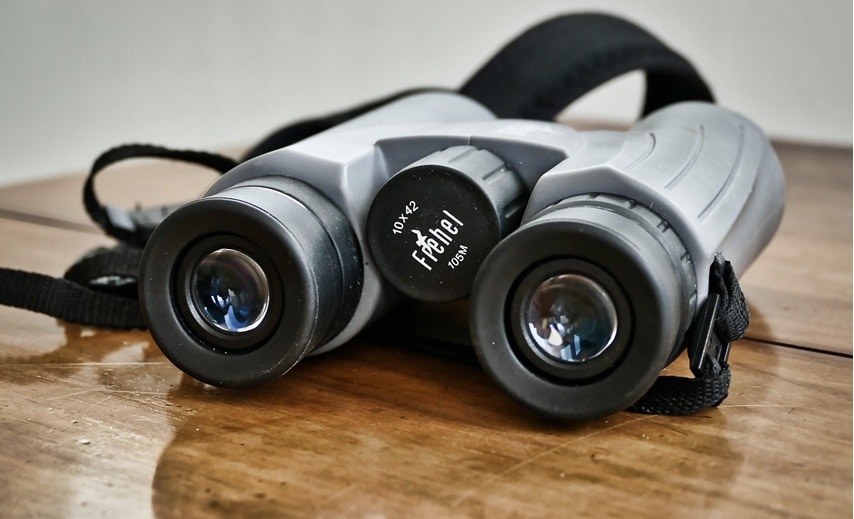
Magnification is the first thing most people notice, yet it’s the most misunderstood. When binoculars are labeled 8x, 10x, or 12x, that number tells you how much closer objects appear compared to the naked eye. An 8x binocular makes something appear eight times closer, while a 10x binocular makes it appear ten times closer.
On paper, higher magnification sounds like an obvious upgrade. Why wouldn’t you want things to look even closer? However, we need to understand that magnification often comes with significant trade-offs.
As magnification increases, image stability decreases. Any natural movement in your hands is amplified along with the image. With 8x binoculars, most people can hold a reasonably steady view. With 10x, small shakes become more noticeable. At 12x, many find the image difficult to stabilize without bracing themselves or using a tripod. I personally can’t do 12x, and I consider myself to be quite steady.
Higher magnification also reduces your field of view, meaning you see less of the scene at once. This makes it harder to spot animals, follow birds in flight, or track fast-moving subjects. It’s one of the reasons experienced birders often prefer 8x binoculars despite having access to higher-powered options.
Brightness is another factor that goes overlooked. Higher magnification spreads available light over a larger image, which can make the view appear dimmer, especially in low-light conditions like dawn, dusk, or shaded forests.
For the average user, I personally recommend 8x magnification, as it offers the best balance of stability, brightness, and ease of use. Ten power binoculars can be excellent for open landscapes and long-distance viewing if you have steady hands.
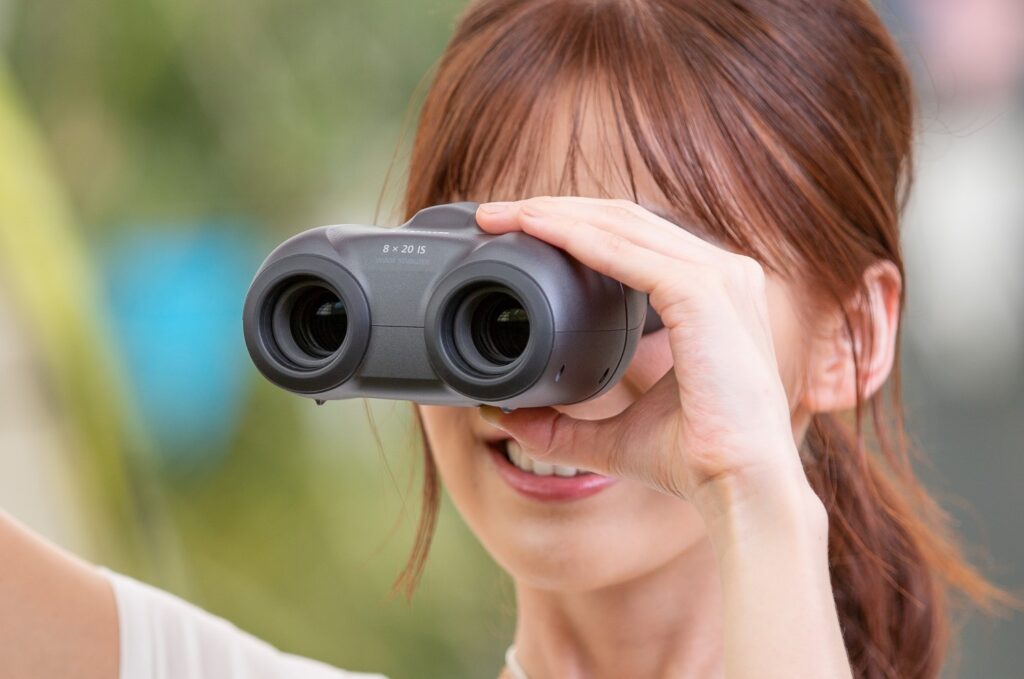
Twelve power binoculars are best reserved for specialized situations or supported viewing. If you don’t mind spending some extra, there are image stabilized binoculars that can help with the jitter of the higher magnification.
The second number in binocular specs refers to the objective lens diameter, measured in millimeters. These are the large lenses at the front of the binoculars, and their size plays a major role in how much light the binoculars can gather.
Larger objective lenses collect more light, which typically translates to a brighter image. This is particularly noticeable in low-light conditions, like with early morning wildlife viewing or evening star watching. The potential downside here is that larger lenses also make binoculars heavier and bulkier, which can be a hassle or downright uncomfortable with long viewing sessions or hikes.
Smaller objective lenses create more compact and lightweight binoculars that are easy to carry and handle, but you’re trading some brightness in exchange, particularly in dim conditions. This trade-off is important to consider based on how and when you’ll actually use your binoculars.
If you’re more experienced, you may want to consider binoculars with 40 – 42mm objective lenses. They’re the best of both worlds, offering excellent brightness while remaining comfortable to hold for long periods.
Larger 50mm lenses can be nice for low-light use or astronomy, but often feel a bit “much” for everyday use. Compact binoculars with lenses under 32mm are great for travel and casual daytime use, but are less versatile overall.
Eye relief is one of the most important specifications and also one of the most overlooked. The term refers to the distance between the eyepiece and your eye at which you can still see the full image clearly.
If you wear glasses, your eyes sit farther away from the eyepiece. Without the right amount of eye relief, you won’t be able to see the entire field of view. The edges of the image will appear cut off, and viewing will feel cramped and uncomfy.
Most modern binoculars are designed with adjustable eyecups that twist or fold to accommodate both glasses wearers and non-glasses wearers. However, the actual eye relief measurement still matters. For glasses wearers, anything under about 15 millimeters can be frustrating. Eye relief of 17 millimeters or more is generally considered comfortable.
Even if you don’t currently wear glasses, adequate eye relief improves overall comfort and reduces eye strain during long viewing sessions. It allows you to position your eyes naturally rather than pressing into the eyepieces.
Field of view describes how much of the scene you can see at once when looking through binoculars. It’s usually expressed as a width measurement at a given distance or as an angular degree measurement.
A wide field of view gives you a more immersive experience and makes it easier to locate subjects. This is especially valuable for birding, wildlife viewing, and sports, where subjects move unpredictably. A narrow field of view can feel like looking through a tunnel, which may be fine for distant, stationary objects but frustrating for anything dynamic.
Field of view is influenced by magnification, optical design, and eyepiece construction. Lower magnification generally provides a wider field of view, which is another reason 8x binoculars are so popular for general use.
While field of view is rarely highlighted in marketing materials, it’s one of the first things people notice when comparing binoculars side by side. Once you’ve experienced a wide, open view, it’s hard to go back to a narrow one. Trust me, I still haven’t, and I don’t plan to! Of course, this comes down to personal preference, too.
Inside every binocular is a prism system that corrects the image orientation so the view appears “accurate”. The image should be upright and correctly aligned. The two main prism designs are roof prisms and porro prisms, and each one comes with different characteristics.
Porro prism binoculars have the traditional zig-zag shape with offset eyepieces. They tend to provide great depth perception and bright images for the price. Because their optical design is simpler, they often deliver solid good image quality at a more affordable cost. The downside is that they’re bulkier and less streamlined, making them less convenient for travel and harder to seal against water and dust.
Roof prism binoculars come with straight barrels and a more compact, sleek design. They’re easier to waterproof, more durable, and generally lighter for their size. You can really throw these things around and put them through everything without worrying.
High-quality roof prism binoculars deliver exceptional optical performance, but they’re more expensive due to being more difficult to make. There are cheaper roof prism models, but I find you’re often compromising image quality if corners are cut.
For most modern users, roof prism binoculars are preferable, thanks to their portability and ruggedness. However, porro prism binoculars are still an excellent value and shouldn’t be immediately dismissed, especially if you’re a newbie or looking to stay on a budget.
Lens coatings are one of the most important factors in binocular performance, yet they’re often poorly explained. Every time light passes through a glass surface, some of it is lost due to reflection. Coatings reduce this light loss and improve brightness, contrast, and color fidelity.
Basic “coated” optics may come with just one coating on one surface. “Fully coated” means all air-to-glass surfaces have a single coating. “Multi-coated” suggests multiple coating layers on some surfaces. The ultimate option is “fully multi-coated,” where every air-to-glass surface comes with multiple anti-reflective layers.
Fully multi-coated optics significantly improve image clarity, especially in low-light conditions. Colors appear more accurate, contrast is sharper, and glare is reduced. This is one area where quality truly matters, and you can really notice the difference when it comes to how “alive” or vivid the image feels.
If there’s one feature I never skimp on, it’s coatings.
“Exit pupil” sounds like some term I’ve only ever heard on an action film. It turns out it refers to the diameter of the beam of light that exits the binoculars and enters your eye. It’s calculated by dividing the objective lens diameter by the magnification.
This measurement matters because your eyes can only accept a certain amount of light. In bright conditions, your pupils are small, and exit pupil size is less critical. In low light, your pupils expand, and a larger exit pupil allows more light to reach your eyes, resulting in a brighter image.
An exit pupil around 5 millimeters is ideal for low-light use. Exit pupils around 4 millimeters work well for general daytime use. Anything much smaller can feel dim, particularly at dawn or dusk.
Exit pupil also affects viewing comfort. Larger exit pupils are more forgiving of slight eye movement, making binoculars easier and more relaxing to use.
Close focus distance is talking about the nearest distance at which binoculars can focus sharply. This spec is particularly crucial for birders, nature lovers, and anyone especially interested in observing insects, flowers, or small details.
Modern binoculars often focus as close as 5 or 6 feet, letting you check out butterflies or nearby birds in insane detail. Older or lower-quality models may struggle to focus closer than 15 feet, which can be limiting and a bit disappointing, in comparison.
While close focus distance may not matter for long-distance viewing, it adds versatility and enhances everyday use. Many people are surprised by how often they end up using binoculars at close range once the option is available.
No single specification determines whether binoculars are good or bad. What’s more important is how all of them work together.
A well-designed pair of binoculars feels natural in your hands, delivers a bright and stable image, and allows your eyes to relax rather than strain. Ideally, they’ll be comfortable and easy to carry around, too. That usually means moderate magnification, sufficient objective lens size, generous eye relief, a wide field of view, quality prism design, and fully multi-coated optics.
Understanding these concepts allows you to look past marketing claims and focus on what actually improves the overall experience.
The best binoculars aren’t the ones with the biggest numbers or the flashiest descriptions. Rather, you’re on the hunt for those that feel comfortable, deliver clear images, and work with how you actually plan to use them.
Think about where you’ll carry them, how long you’ll hold them, whether you wear glasses, and when you’ll use them most often. Those answers matter far more than chasing the highest magnification or massive lenses.
When chosen carefully and intentionally, binoculars become an extension of your curiosity – something you reach for instinctively when you want to see the world more clearly. What’s the point, otherwise?

 About us
  Contact Us